In reality, there are over 200 independent states in the world; however, the official number of countries is lower. There are many reasons why certain territories are not considered states.
Countries of the World
It is difficult to determine exactly how many countries exist worldwide. The number varies depending on the criteria used. There are no fewer than 194 countries (those that enjoy widespread global recognition), all of which (except for the Vatican) are also members of The United Nations (UN). Sometimes, UN membership is considered a key determinant of being recognized as a state. When including unrecognized or partially recognized states that control their own territory, there are approximately 205 states.
Political map of the world
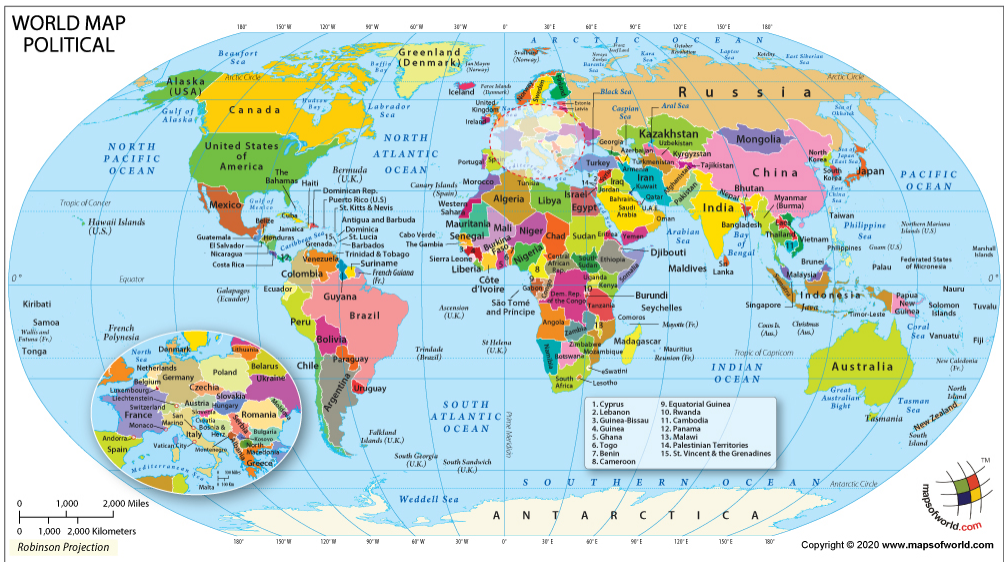
Source: https://www.mapsofworld.com/world-political-map.htm
1. Criteria for Recognizing an Entity as a State
- It possesses and controls its own (land) territory that is not governed by another state and has clearly defined borders (or at least part of its territory).
- It has its own population (at least one person in practice).
- It has a government that exercises actual control over the territory and population and is independent of other states.
- It has declared independence, specifying its name, capital, and international symbols (e.g., flag, anthem).
- It enjoys international recognition by other states in the world. In practice it is important for a country to be not disputed by some major powers like United States, European Union, China and Russia.
In practice, the last requirement is the most crucial, as many de facto independent territories are not universally recognized and therefore do not hold the status of a state. Some entities are supported by only a few countries worldwide (e.g., Taiwan), while others, such as Kosovo (recognized by about 100 other independent states), are acknowledged by many important countries but lack a consensus on independence due to opposition from significant powers (e.g., Russia, Spain, China, India, and about 100 other countries). While declaring independence despite Serbia’s opposition seems possible, achieving it despite opposition from major world powers is much more challenging. The most recent country to successfully declare and gain international recognition of its independence is South Sudan, often called the “youngest” country in the world (2011).
2. Countries of the World by Continents
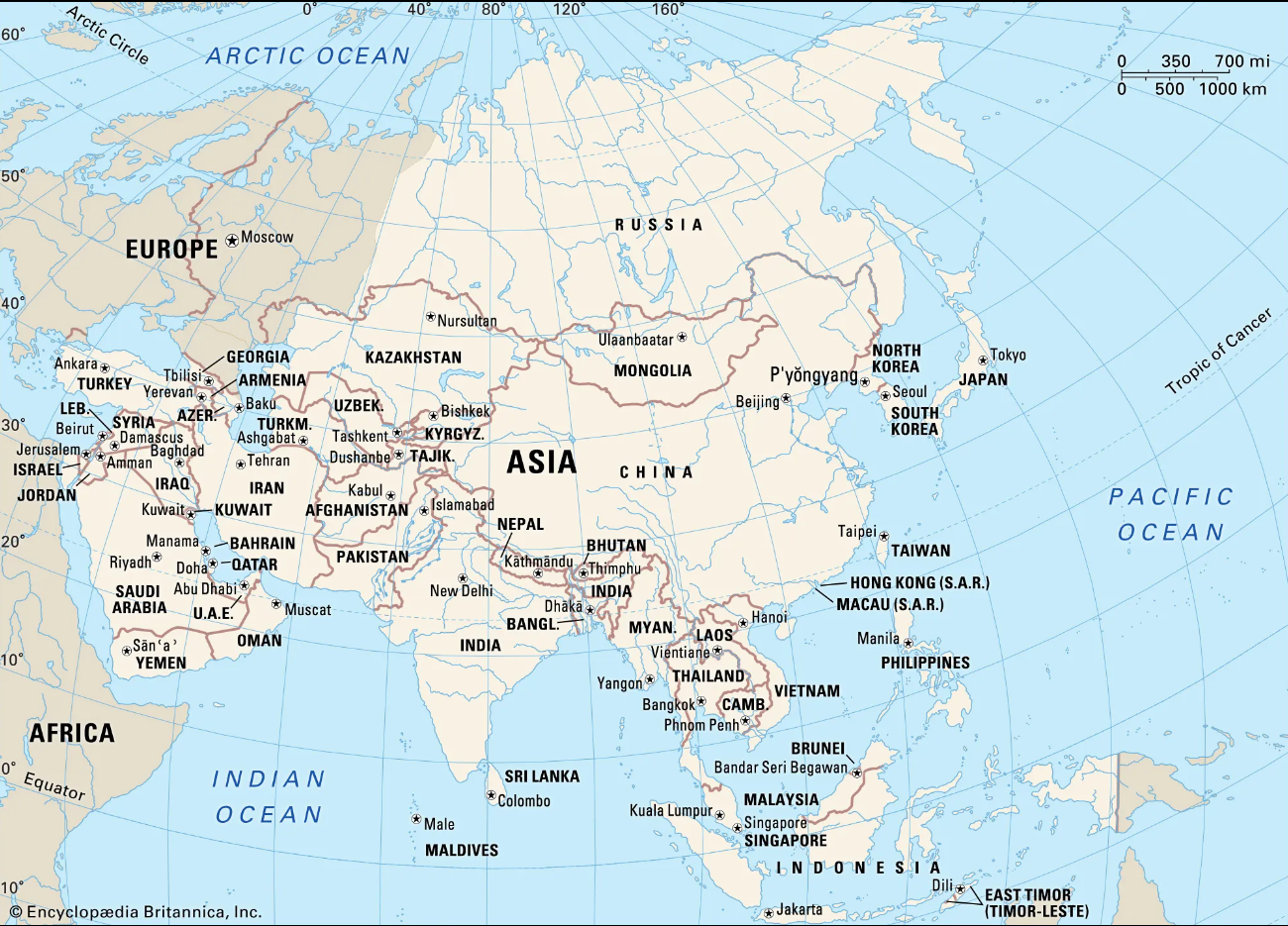
Asia – consists of 48 recognized countries: (+ Russia) and 5 unrecognized states: (Taiwan [Republic of China] – a former UN member, Palestine [UN observer status], Abkhazia, South Ossetia, Northern Cyprus). In the past there was also Nagorno-Karabakh quasi-state, but was dissolved by Azerbaijan military offenisve. Largest country is China: 9,6 mln km2 (excluding Russia) who also used to be the most populous, but in 2024 was overtaken by India (1 440 000 000 citizens) who is since then the most populoust country in the world. The smallest country is Maldives (300 km2) and least populous country is Brunei (About 380 000 people).
Political map of Asia
Source: Encyclopædia Britannica; https://www.britannica.com/place/Asia#/media/1/38479/539
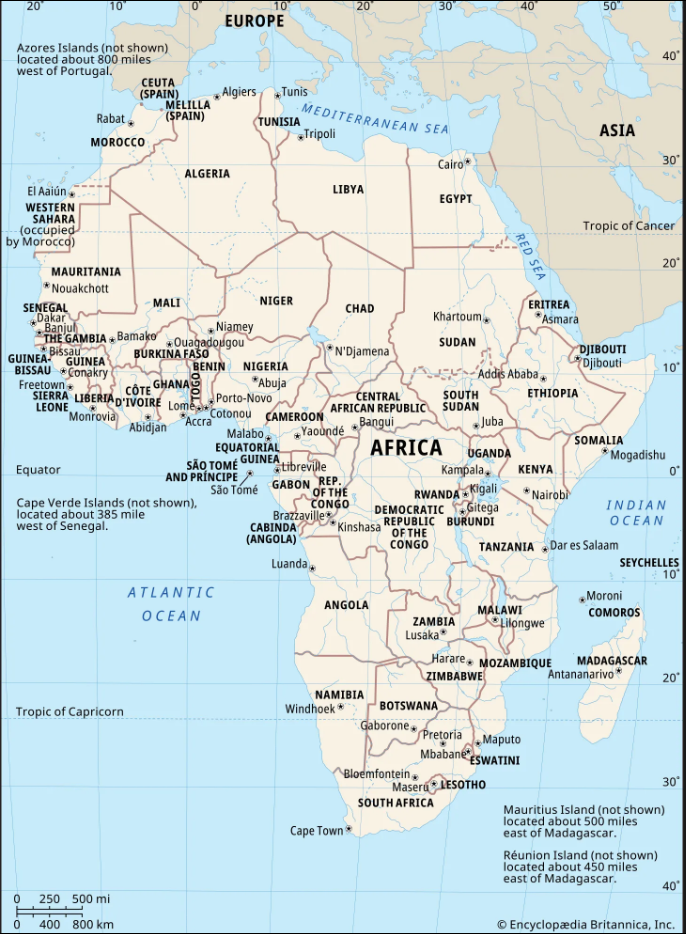
Africa – consists of 54 recognized countries which is the highest amount of all continents. There are also 2 unrecognized states (Western Sahara and Somaliland). Largest country is Algeria (2,38 mln km2), and most populous is Nigeria. Smallest country by both area and population is Seychelles (455 km², about 94 000 people).
Political map of Africa
Source: Encyclopædia Britannica; https://www.britannica.com/place/Africa#/media/1/7924/198
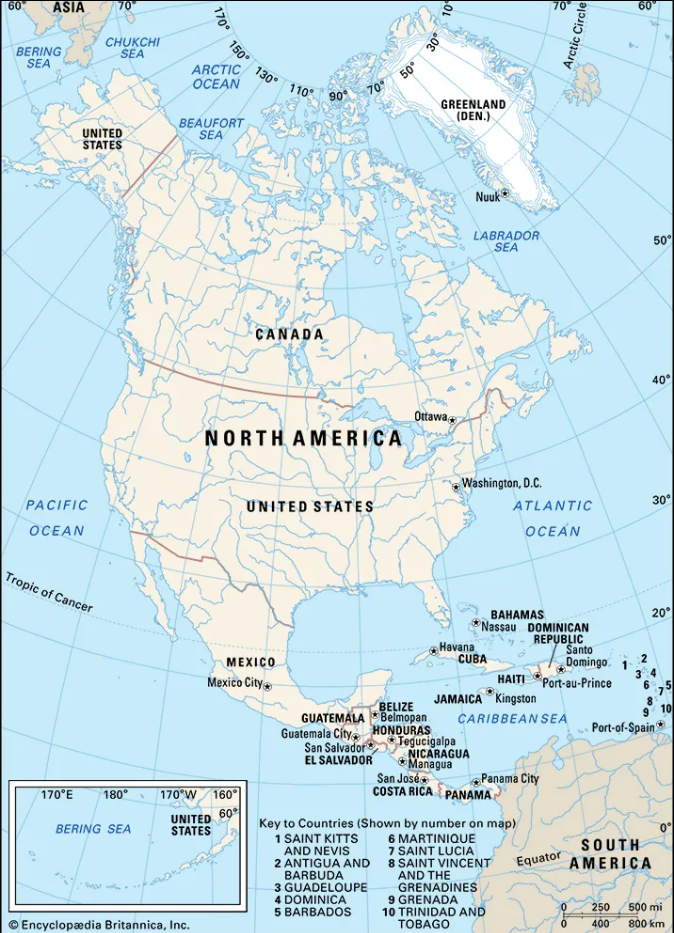
North America – consists of 22 recognized countries. Largest country by area is Canada (9,98 mln km2), but the most populous is the USA (over 340 mln people). Smallest country by both indicators is Saint Kitts and Nevis (261 km², 55 000 people).
Political map of North America
Source: Encyclopædia Britannica; https://www.britannica.com/place/North-America#/media/1/418612/46537
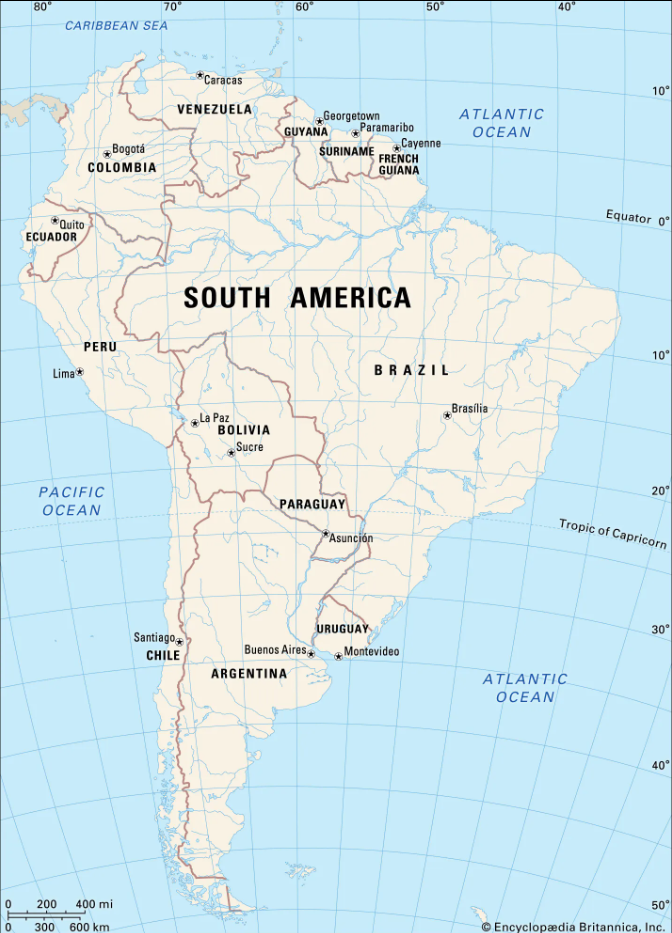
South America – consists of 13 recognized countries with the largest and most populous Brazil (8,52 mln km2, 212 mln population). Smallest countries are: Trinidad and Tobago by area (5,000 km²) and Suriname by citizens (590,000 people).
Political map of South America
Source: Encyclopædia Britannica; https://www.britannica.com/place/South-America#/media/1/555844/3438
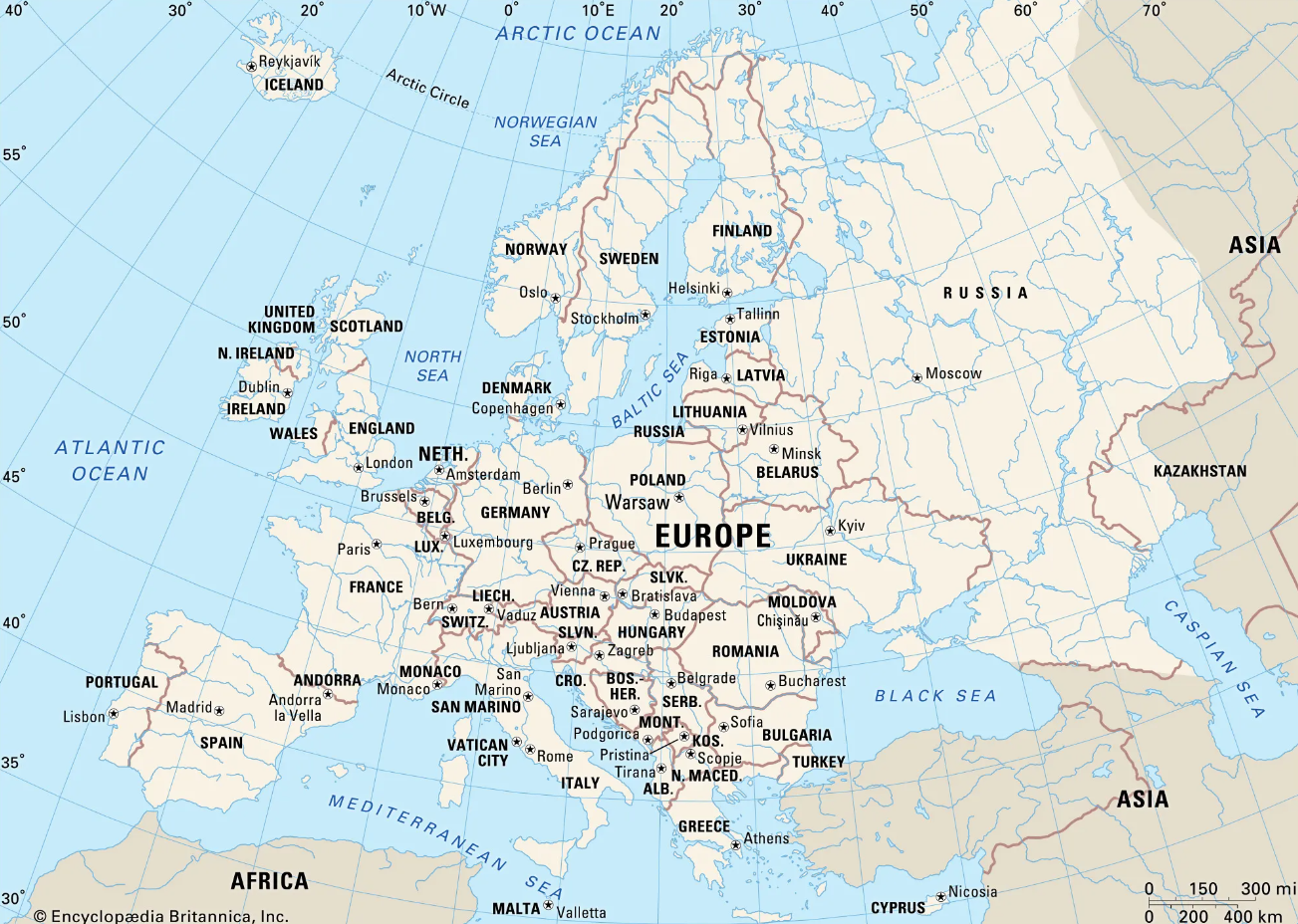
Europe – while one of the smallest continents it has a huge amount of 44 recognized countries and 2 more unrecognized (Transnistria and Kosovo, the latter being recognized by most European nations). Largest and most populous country is Russia (17,13 mln km2 land area and about 143 mln of citiznes) who also occupy some territories and population of Ukraine. Smallest and least populous country is Vatican City, being the smallest state in the world in the same time (0,49 km2 area, less than 1000 citizens).
Political map of Europe
Source: Encyclopædia Britannica; https://www.britannica.com/place/Europe#/media/1/195686/1453
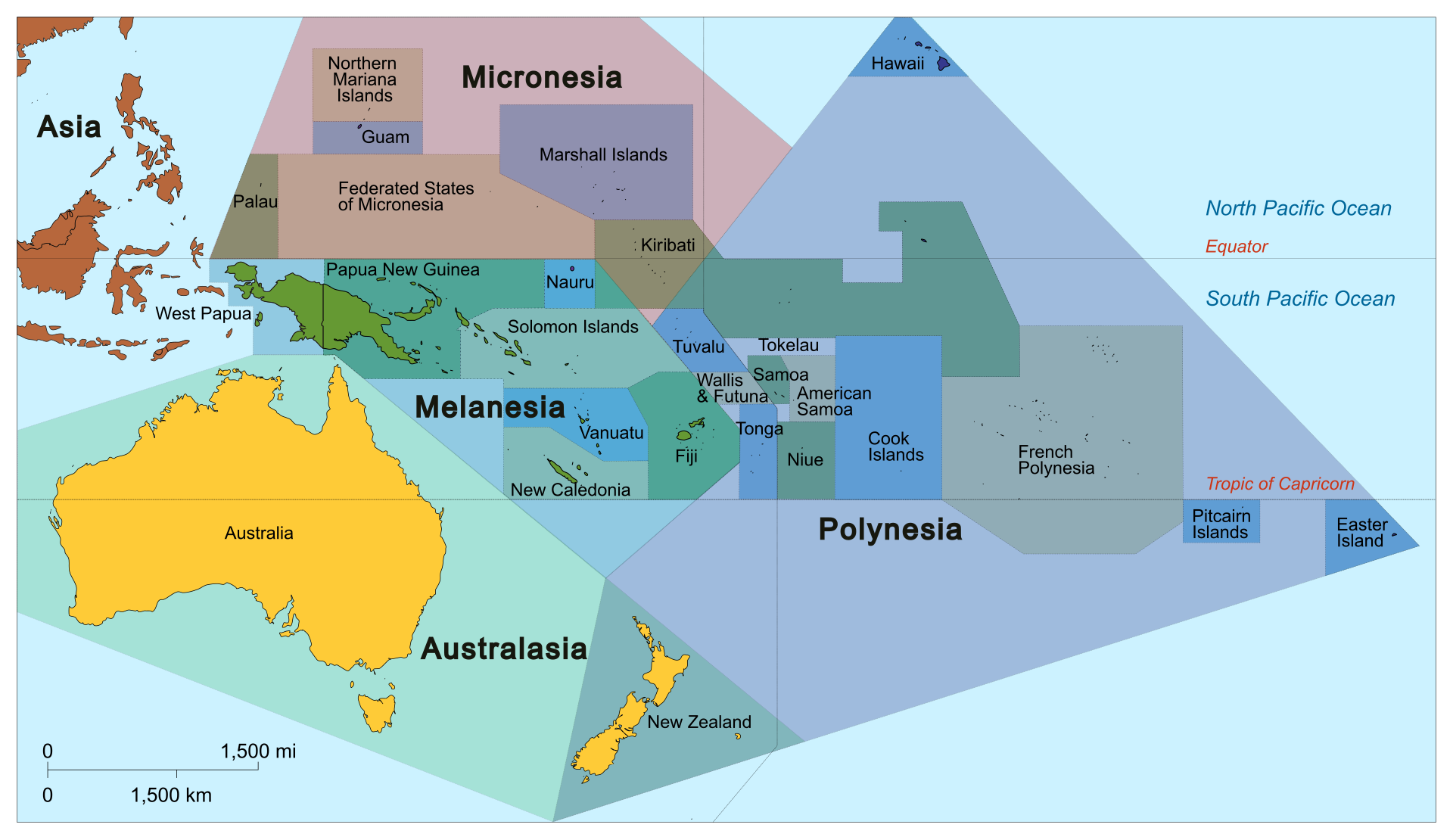
Australia and Oceania – has the lowest amount of recognized countries which is 14, but there also 2 de facto independent but formally dependent territories: 2 (Cook Islands and Niue, dependent on New Zealand) and many other archipelagos potentially interested in becoming newly independent countries. Largest and most populous country is Australia (7,69 mln km2, but only about 27 mln of citiznes). Smallest country by area is Nauru (21,3 km2) and least populous is Tuvalu (about 10 000 population).
Political map of Oceania
Source: https://en.wikipedia.org/wiki/Oceania#/media/File:Oceania_UN_Geoscheme_-_Map_with_Zones.svg; Oceania_ISO_3166-1.svg: User:Tintazul derivative work: Cruickshanks – Own work, derivative of Oceania_ISO_3166-1.svg
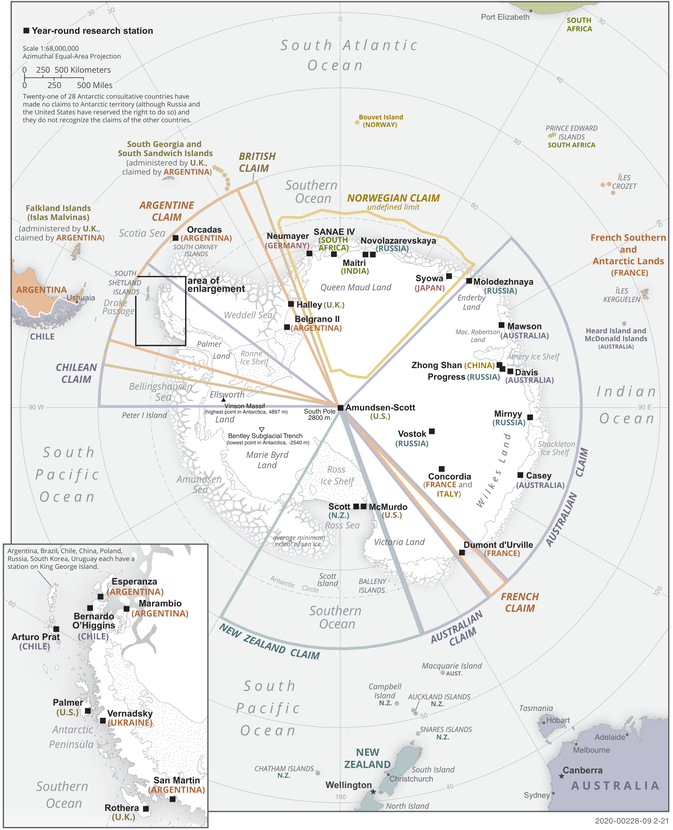
The last continent – Antarctica – has no countries or permanent inhabitants. The status of this continent is regulated by the Antarctic Treaty of 1959, which assumes that this continent constitutes an international area, independent of all countries. It is subject to a ban on the exploitation of raw materials (until 2048) and the freedom to conduct scientific research. However some neighbour and former colonial nations already claimed some areas of Antarctica. They are mostly unrecognized by other countries in the world.
Political claimes made to Antarctica tertory
Source: https://www.cia.gov/the-world-factbook/static/5891ad778f8f6ca2babc96f4bc18e3ea/antarctic_pol.pdf
3. Unrecognized or Partially Recognized States
Map of territories with disputed status
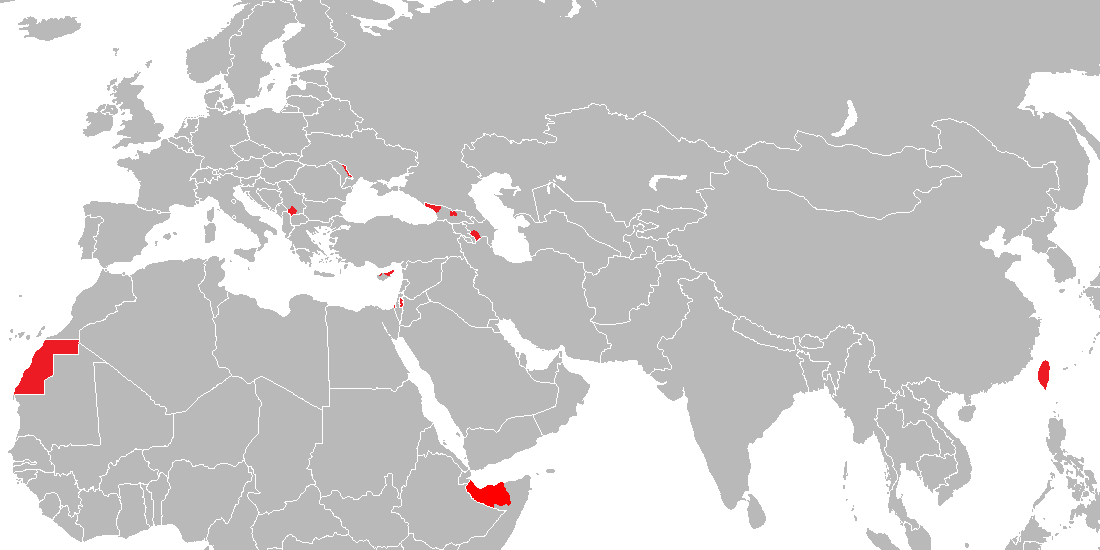
Source: https://en.wikipedia.org/wiki/List_of_states_with_limited_recognition#/media/File:Limited_recognition.png – with own edition
The status of disputed territories varies by case:
- Western Sahara (officially the Sahrawi Arab Democratic Republic) – A former Spanish colony seeking independence but currently controlling only its eastern part. Morocco claims the entire territory as its own. Western Sahara’s independence is recognized by about 40 countries (not including Poland).
- Kosovo – Declared independence in 2008 following a war with Serbia and international intervention. Recognized by about 100 of 193 UN member states but considered by Serbia as a rebellious province. Countries allied with Serbia, including Russia, Ukraine, and Spain, do not recognize its independence. Poland was one of the first countries to recognize Kosovo.
- Transnistria – Broke away from Moldova after the Soviet Union’s collapse. It is not recognized by any major country, not even Russia, its main supporter. It is recognized only by other unrecognized states (Abkhazia, South Ossetia, and Nagorno-Karabakh) and is considered a breakaway province of Moldova.
- Abkhazia and South Ossetia – Declared independence from Georgia in the 1990s and became de facto independent after the 2008 Russia-Georgia war. Recognized by only a handful of UN members, including Russia. Georgia (and Poland) consider them part of Georgian territory.
- Nagorno-Karabakh (also known as Artsakh) – Generally recognized as part of Azerbaijan but de facto independent since 1991. Recognized only by Abkhazia, South Ossetia, and Transnistria.
- Northern Cyprus – Declared independence in 1983 following a Turkish military intervention. Recognized only by Turkey, though it fully controls its territory. The Republic of Cyprus considers it part of its territory. Cyprus, though geographically in Asia, is part of the European Union, but EU law is indefinitely suspended in Northern Cyprus.
- Palestine – In an ongoing conflict with Israel, theoretically an autonomous territory but with observer status at the UN. De facto independent but under partial Israeli occupation. Recognized by 139 countries, including Poland, but not by the US or most Western European nations.
- Somaliland – Separated from Somalia in 1991 and has been functionally independent for nearly 30 years. However, it is not internationally recognized and is officially considered an autonomous region of Somalia.
- Taiwan (Republic of China) – Officially existed since 1947 and was China’s representative at the UN until 1971. Established following the Chinese Civil War, after the nationalist government fled to Taiwan. It considers itself the legitimate government of China. Since 1971, it has been recognized by only a few countries, including the Vatican. De facto fully independent, it maintains strong ties with most nations despite lacking formal recognition.
This classification illustrates the complexities of international recognition and the political challenges that influence a state’s status on the world stage.
No Comments Yet